How We Made Super Simple Songs Actually Work in 4 Months
Turn Super Simple Songs from background noise into real learning. Free 4-step routine + TPR tips for toddlers and preschoolers.
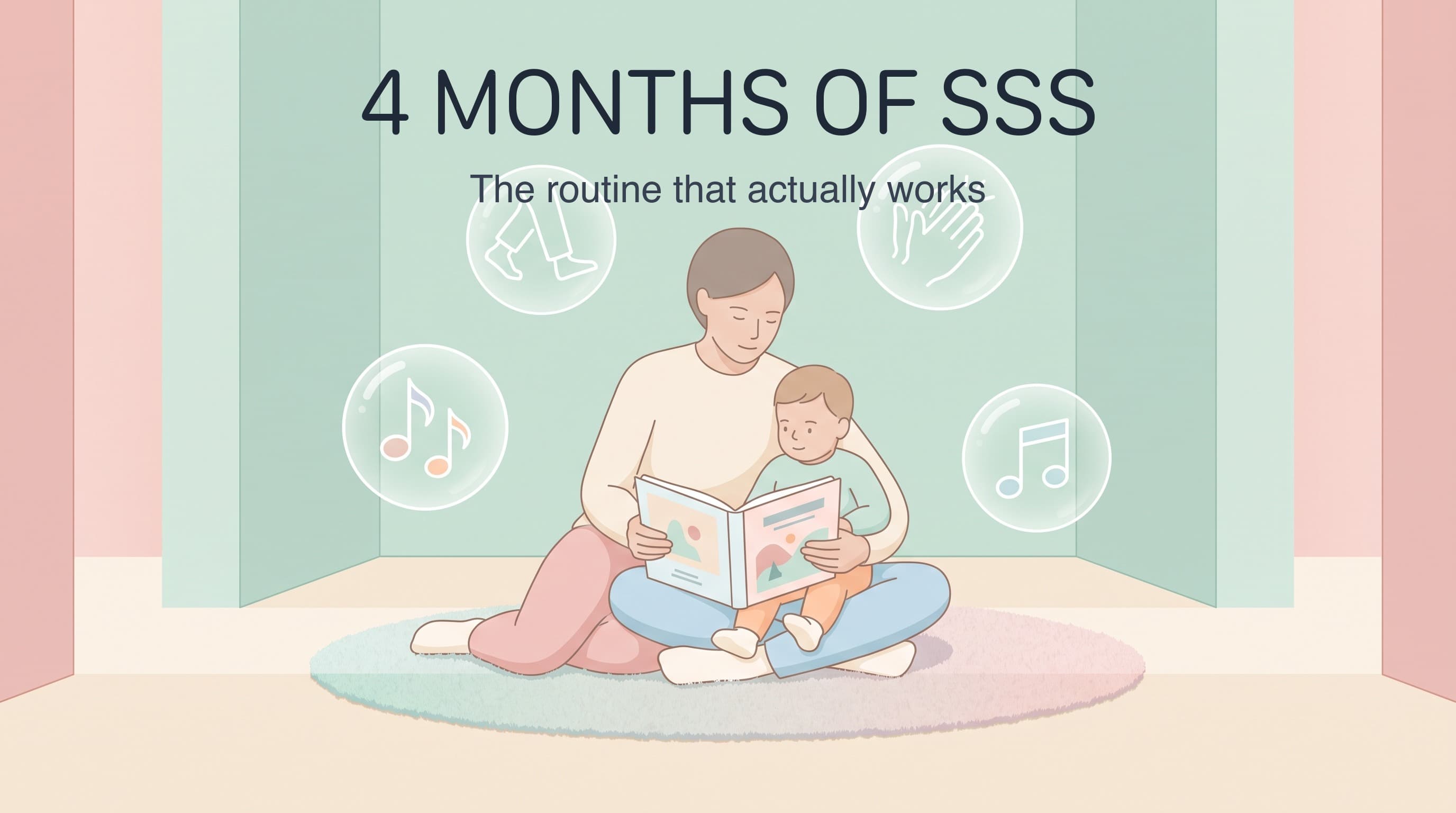
When my daughter was about eighteen months old, I started playing Super Simple Songs the way most parents do: I pressed shuffle and hoped the English would somehow soak in. A few weeks later she could hum the tunes, but when I pointed to her nose and said, “Where is your nose?” she looked at me like I had asked her to solve a puzzle.
That was the moment I realized SSS is not background music. It can be an incredibly effective early English tool, but only if you give it a little structure.
Four months later, she says little phrases like “thank you” and “you're welcome” unprompted, and she understands everyday words that show up in our routines. The change did not come from listening more. It came from changing how we used the songs.
Here is the four-step routine that made the difference.
Step 1: Watch together first
We started with a short, predictable window: fifteen to twenty minutes after dinner, every day. The screen went on, but this was not passive TV time. I sat with her, sang along, and did the actions.
- When the song said walking, we walked around the room.
- When it said jumping, we jumped.
- When it said clap your hands, we clapped together.
- When Head Shoulders Knees & Toes came on, we touched each body part.
This is the heart of TPR, or Total Physical Response. By pairing the English sound with a movement or a touch, the words stop being abstract noise and become something her body understands. She did not need a translation. She needed the word and the meaning to arrive at the same time.
Your presence matters more than your singing voice. A parent who looks silly and engaged will always beat a perfectly pronounced recording playing in the background.
Step 2: Listen after they understand
Once I had seen her respond to the video and the actions, I started playing the same songs as audio during the day: in the car, during play time, while we tidied up toys. The important part was that she already knew the song. The audio was review, not first exposure.
At first I worried she would get bored. Instead, something interesting happened: she started asking to skip songs. That tiny request was actually a great sign. It meant she recognized the songs, had preferences, and was listening with attention instead of just letting the sound wash over her.
When a child already understands the content, repeated listening becomes reinforcement. Before that point, it is mostly noise.
Step 3: Let them review independently
We made a simple lyric book and a few song cards she could look at on her own. Sometimes she used a pointer pen; sometimes she just flipped the pages and hummed. Almost always, she went back to the same handful of songs.
At first I thought, “Why doesn't she try something new?” Then I realized that repetition is not laziness for a toddler. It is how they build confidence. Every time she returned to a familiar song, she was strengthening the connection between the sound, the picture, and the meaning.
You do not need fancy materials. A printed lyric sheet, a small photo album of song screenshots, or even hand-drawn cards can work. The goal is to give your child a way to revisit what they already love.
Step 4: Bring the words back to real life
This step was the real game changer. Songs are powerful, but if the words never appear anywhere else, they stay inside the music.
I started deliberately using SSS vocabulary during ordinary routines:
- At bath time: “Let's wash your hair. Can you touch your head? Where are your hands? Where are your feet?”
- At the park: “Do you want to walk? Let's run! Can you jump? Now stop!”
- At the grocery store: “Look, an apple. Do you see the banana? Orange or grapes?”
None of this felt like a lesson. I was simply saying the words in the exact moments they made sense. After a few weeks, she began responding without the song playing. The English had moved out of the screen and into her actual life.
Quick-start routine
If you want to try the same approach, here is the simplest version:
- Watch together daily. Fifteen to twenty minutes is enough. Sing, move, and act silly together.
- Play familiar songs during the day. Car rides and play time are perfect.
- Offer song cards or a lyric book for self-guided review.
- Use 3–5 words from the songs in real routines each day: bath, meals, park, store, bedtime.
Consistency beats intensity. A short, happy session every day will outperform an occasional long one.
3 self-check questions for parents
Whenever I feel unsure about whether we are making progress, I ask myself:
- Does my child understand the song? Can she do the action, point to the picture, or finish a line?
- Does she react to it? Does she smile, move, skip ahead, or ask for repeats?
- Do the words show up in real life? Am I using the vocabulary outside of screen time?
If the answer to all three is yes, the input is working. If not, I know exactly which step to adjust.
Conclusion
Super Simple Songs did not work for us because we played them more often. It worked because we turned them into a small system: watch with actions, listen once it is familiar, review independently, and then bring the words into everyday life.
The best part is that none of this requires perfect English from the parent, expensive materials, or long hours. It just requires showing up, staying playful, and trusting that understanding comes before speaking.
There will be days when your child seems uninterested or when the same song feels tired. That is normal. The routine is not about perfection; it is about keeping the door open. On hard days, we simply watched for five minutes, did one silly action, and called it a win. The next day, she was ready again.
If you are just starting, pick one song, do the actions together, and use one word from it tomorrow morning. That single word, used in a real moment, is worth more than a hundred plays in the background.
Free Super Simple Songs resources
- SSS 30 Best Songs for Beginners — a free printable two-stage song list based on what actually works for English listening beginners.
- Free Printable TPR Action Cards — turn any action song into a movement game.
- Free Printable Animals Flashcards — animal vocabulary cards for Old MacDonald and other animal songs.
- Free 4-Week Super Simple Songs Morning Routine — a weekly plan + daily checklist to build a calm morning habit.
- I Played Super Simple Songs for 2 Years — Here Is What Actually Works — the biggest mistakes and a 3-tier difficulty system.
Get a personalized AI plan
This four-step routine works for many families, but every child is different. If you want a custom Super Simple Songs plan built around your child’s age, native language, and daily schedule, our AI can generate one for free in under a minute.
Happy singing — and happy moving!
Get a free AI Super Simple Songs plan
Tell us your child's age, language, and goals. Our AI builds a weekly routine with the right songs, activities, and printable ideas in under a minute.
Create My Free Plan