How to Build 300-500 English Listening Vocabulary with Super Simple Songs
A song-by-song vocabulary map: 11 Super Simple Songs organized by theme with the exact words each one teaches, plus a 3-step material path from total beginner to Cocomelon.
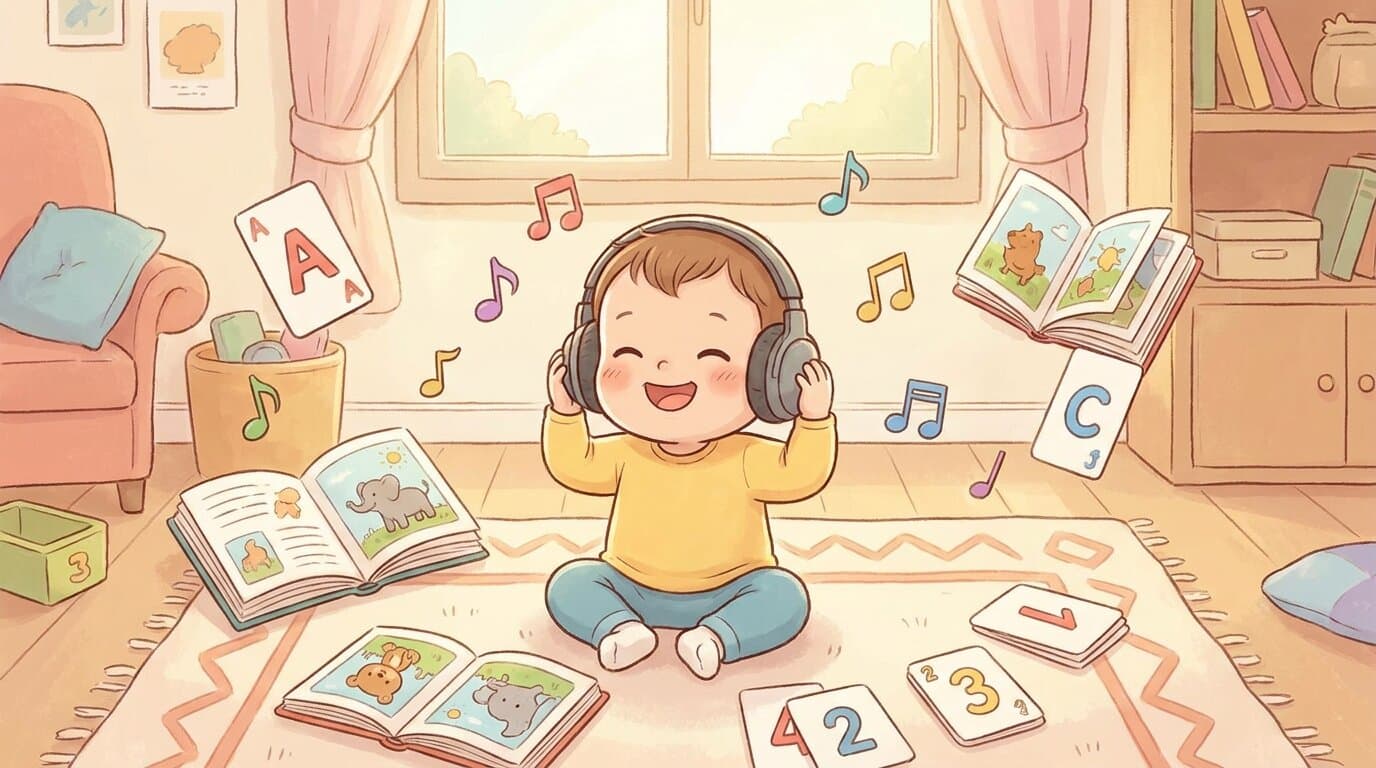
Listening vocabulary is the hidden engine behind speaking, reading, and writing. Before a child can say a word, they need to have heard it many times in a meaningful context. For young learners, nursery rhymes are the single best tool for building that foundation.
My daughter's first 300+ English listening words came almost entirely from songs. Even tricky words like planet names stuck because they were attached to a melody she loved.
This guide shows you exactly how: which materials to use in what order, which songs deliver which words, and how to sing those words into daily life so they stick.
Why songs work so well
Songs combine three things young brains crave:
- Repetition — the same words come back again and again
- Rhythm — melody makes words easier to remember
- Context — pictures, actions, and routines give words meaning
When a child hears the body-parts song while touching each body part, the words are no longer abstract. They become an experience.
One warning before the method: songs are not background music. A child can hear a word five hundred times as noise and still not know what it means. Everything below is about making the words understandable.
The material path: start easy, level up
Use these three resources in order. Each one has a job.
Step 1: Super Simple Songs (zero-base starting point)
If you only use one resource, make it Super Simple Songs. With roughly 280 songs ranging from very easy to quite advanced, slow clear singing, and built-in actions, it covers everything a first-year listener needs.
Best for: ages 1–6, total beginners Strength: everyday nouns, action verbs, colors, numbers, animals
Step 2: Child's Play illustrated song books
Once a handful of songs are familiar, add these screen-free picture books. Each book is built around a classic song, with rich illustrations and repetitive language — a single book quietly introduces 10–20 new words.
Best for: ages 1–4, after the first few songs are known Strength: picture-rich context, bedtime-friendly, tactile
Step 3: Cocomelon (the continuation, not the start)
Cocomelon works best as the next channel after SSS, not the first. The production is bigger and faster, and the language is harder to parse for a total beginner. Many families graduate to it once a child has a base of a couple hundred words. For a full comparison, see Super Simple Songs vs Cocomelon vs Ms Rachel.
Best for: ages 2–5, after SSS Strength: highly motivating, familiar topics in longer episodes
The song-by-song vocabulary map
This is the part most guides skip: which song teaches which words. Here are 11 high-value Super Simple Songs organized by theme, with the core vocabulary each one delivers.
| Theme | Song | Core words your child picks up |
|---|---|---|
| Animals | Old MacDonald Had A Farm | cow, pig, duck, horse, sheep, farm |
| Animals | The Animals On The Farm | chicken, sheep, dog, cat, duck, pig |
| Animals | I Have A Pet | pet, bird, fish, mouse, cat, dog |
| Colors | I See Something Blue | blue, yellow, red, purple, green, orange |
| Colors | I See Something Pink | pink, black, brown, white, gray, tan |
| Body parts | Head, Shoulders, Knees And Toes | head, shoulders, knees, toes, eyes, ears, mouth, nose |
| Body parts | One Little Finger | finger, head, nose, chin, arm, leg, foot |
| Vehicles | The Wheels On The Bus | bus, wheels, door, wipers, horn, people |
| Vehicles | I've Been Working On The Railroad | train, railroad, engine, whistle, track |
| Numbers | Five Little Ducks | one to five, duck, mother |
| Numbers | Ten In The Bed | six to ten, bed, roll over |
That is roughly 70 core words from 11 songs. Ready-made printable cards exist for several of them: Old MacDonald, Head, Shoulders, Knees And Toes, The Wheels On The Bus, and Five Little Ducks.
How 70 core words become 300–500
The table is the seed, not the harvest. Each core word grows into a word family when you use it in real life:
- cow → moo, cow says moo, big cow, brown cow — animal sounds and adjectives
- blue → find something blue, blue car, blue sky — color hunts on every walk
- five → count five steps, five grapes, five fingers — numbers applied to everything
- wash → wash hands, wash face, wash your toes — routines extend every verb
Two songs a week, extended through play, easily compounds past 300 words within a year. The key rule: avoid letting all songs come from one theme. An all-animal playlist makes an animal expert, not a vocabulary. Rotate themes across the week — the 1-week plan below does this for you.
How to turn songs into vocabulary growth
1. Make the input understandable
Sit with your child for 10–15 minutes a day. Point to the picture or the real object as the song mentions it. Do the actions together — this is the TPR method, and it is what turns hearing into understanding. The goal is not perfect pronunciation; the goal is comprehension.
2. Sing the songs into real life
This is the step that separates 50 words from 300. Take the songs out of screen time and into routines:
- Bath time becomes the washing-song moment — name each body part as you wash it.
- Tidy-up time gets its tidy-up song, sung while putting toys away.
- Getting dressed, eating, leaving the house — each routine adopts a song, and the routine itself teaches the words.
You do not need a good singing voice. You need consistency: the same song, same moment, every day.
3. Go broad, then deep
Cover all five themes in the map before doubling down on your child's favorite. Breadth first ensures the 300-word base is well rounded; depth later keeps motivation high.
What success looks like at this stage
Do not expect your child to sing every word perfectly. The real win is when they:
- understand the main idea of a song
- point to the right picture when they hear a word
- try to join in, even if only with sounds or gestures
- respond correctly when you use a song word in daily life
That is the first successful step toward real language use.
Sample 1-week mini plan
| Day | Theme | Suggested songs |
|---|---|---|
| Monday | Body parts | Head Shoulders Knees And Toes, One Little Finger |
| Tuesday | Animals | Old MacDonald Had A Farm, The Animals On The Farm |
| Wednesday | Colors | I See Something Blue, I See Something Pink |
| Thursday | Numbers | Five Little Ducks, Ten In The Bed |
| Friday | Routines | This Is The Way, The Bath Song |
| Weekend | Review | Let your child pick two favorites |
Spend 10–15 minutes per day. Repeat the same 1–2 songs all week so the words really sink in.
Free Super Simple Songs resources
- SSS 30 Best Songs for Beginners — a free printable two-stage song list for English listening beginners.
- Free Printable Animals Flashcards — animal vocabulary cards.
- Free Printable TPR Action Cards — movement cards for action songs.
- Free 4-Week Super Simple Songs Morning Routine — weekly plan + daily checklist.
- 20 Super Simple Songs That Build 1000 English Words — the extended song list for after the first 300 words.
Next step: get a personalized plan
Every child is different. If you want a plan tailored to your child's age, language background, and daily schedule, you can create one for free:
Have questions about teaching English through songs? The first 300 listening words are the hardest — once they are in place, everything else accelerates.
Get a free AI Super Simple Songs plan
Tell us your child's age, language, and goals. Our AI builds a weekly routine with the right songs, activities, and printable ideas in under a minute.
Create My Free Plan